
As the warmth of the Antalya sunshine begins to fade, the memories and connections of GCF 2026 remain vivid. Four days gave us a great deal to think about. Here is what stays with me from the Forum.
Monday focused on two key priorities: sustainability and cash promotion.
The plenary room was full for the workshop by the ICA Sustainability Committee. Chaired by Alexandra Peppmeier, industry, central bankers, academics and other experts worked through the tough choices required to make the cash cycle support our environmental goals: extending banknote life, reducing waste, improving efficiency, and treating environmental protection and operational reliability as reinforcing rather than competing goals. It was striking to see so many people in the room engaging together on questions that often get treated as somebody else’s problem.
In the Cash Promotion Workshop that followed, we tackled a question that has run like a thread through the rest of the GCF: how do we make the case for cash to policymakers, to the public, and to the next generation? Clémentine Cazalets of Monnaie de Paris walked us through her analysis of cash use around the world. Her conclusion: people want cash; what is changing is how they use it. Annette Holdermann and I then presented some of ICA’s work over the past twelve months: the “Summer of Cash” social media campaign, the continued growth of Cash Matters, the inaugural Global Cash Day, and the “Cash Welcomed Here” leaflets that put cash advocacy directly in the hands of small businesses.
Heimo Ertl of Geldservice Austria, part of the Austrian National Bank, then showed us what proactive central bank promotion looks like in practice: working with students, partnering with the chamber of commerce, even running a cash fan-shop. Austria remains the European benchmark.
On the theme of stronger together, we also brought our two coalitions into the room. Tanja Kulisch-Ziemens, Secretary General of the International Security Ligue’s Cash Chapter, described the work of the Cash Alliance we are building together, and its current focus on important improvements to the EU legal tender regulation now moving through the legislative process. Jim Pettit joined us from the United States to share how the Payment Choice Coalition is working on federal legislation that would ensure the US dollar is universally accepted as legal tender. Both reminded us that advocacy only becomes policy when we act together.
During the day we also hosted meetings of the members of the International Association of Currency Affairs (IACA) and the Banknote Ethics Initiative (BnEI), reinforcing the role of the GCF as the place where the currency community comes together.
Trust and the Value of Cash

Tuesday opened with a heartfelt welcome from Deputy Governor Gazi İşhak Kara of the Central Bank of the Republic of Türkiye. His vision: cash and digital currencies are not rivals but complements. And Türkiye proves the point: forty percent of daily transactions in the country are still cash-based, supported by one of Europe’s largest in-house printing infrastructures and a network that has demonstrated its resilience through pandemic, through earthquakes, and through financial volatility.
Mehmet Sercan Arslan, Director General of the Banknote Printing Plant, then unveiled the Bank’s first house note, “From Past to Future”, connecting Sardis, the birthplace of money, with the Istanbul Financial Centre. A reminder that the birthplace of money is exactly the right place to discuss its future.
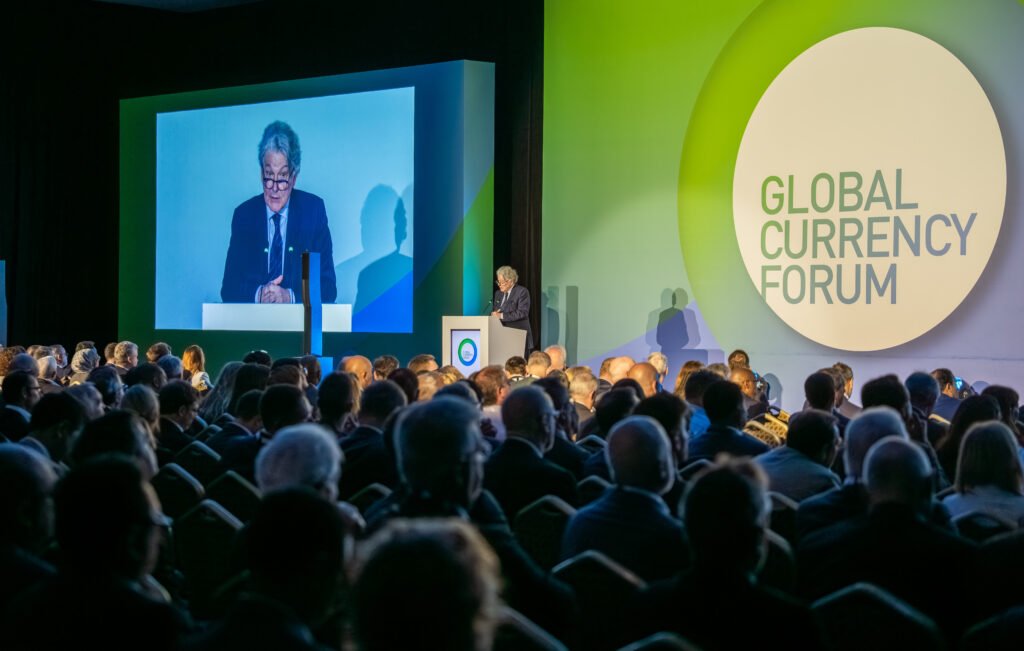
Our keynote speaker, Thierry Breton, then lifted us out of the technical and into the geopolitical. His message stays with me: trust is eroding, and a balance-of-power world is emerging in its place. Sovereignty now extends deeply into the digital domain. Money equals trust, and currency institutions, he reminded us, sit at the very centre of that responsibility. Trust is the foundation of everything we do, and I am left with a constant question: what can we as individuals or organisations do to contribute to rebuilding trust?
And then, perhaps the practical centrepiece of Day One, Professor Julia Pitters, Pearl Kgalegi of the South African Reserve Bank, and Stefan Hardt of the Deutsche Bundesbank presented their work on the value of cash. Until now, everyone has only been looking at the cost of cash: the cost of production, of distribution… The value of cash for national security, resilience, privacy, inclusion, spending discipline, and support for local economies has been left uncalculated. The academic team led by Julia Pitters has developed a formula that puts the value of cash in Germany at 1.28 percent of GDP. That is about three times the cost of the cash cycle, and in absolute terms, around €52 billion. The early signals from the South African study point in the same direction, with inclusion and the informal economy weighing even more heavily. These are striking numbers, and they show that everyone has been looking at only one side of the balance sheet, the cost. When you calculate the value, you finally see the whole picture.
Following on was a discussion on sovereign payment ecosystems, exploring how cash and digital are interlinked and how they support the sovereignty of our national payment systems. Led by John Orchard, Chairman of the Digital Monetary Institute, with Rick Soedamah of the Central Bank of Suriname and Tim Hermans of the National Bank of Belgium, it was one of the deeper conversations of the Forum. Hearing two central bankers from contexts as different as their economies, and seeing how their perspectives complemented each other, was something delegates remarked on for the rest of the week.
Resilience
Wednesday was about resilience.
Our second keynote speaker, Burkhard Balz of the Deutsche Bundesbank, gave us his framing: there is no glory in prevention. People expect cash to work, always, and that only happens when the infrastructure beneath it is strong, accessible, and well maintained. He reminded us that cash is the only form of central bank money used directly by the public, and that the Euro Single Currency package is essential to safeguard its acceptance and availability.
Pascal Wicht then took us into perception, with Peder Natvig of Norges Bank, Kerry Counts, Angela Chileshe of the Bank of Zambia, and Matthias Schroth of the Austrian Nationalbank. Angela on communicating across regions and audiences. Peder on operating in a declining-cash market: neutral, but not passive. Kerry on engaging the youth. Matthias on central banks’ independence and their role in promoting and defending their product. You can be neutral, but active. Reframing cash requires passion, conviction and creativity. And let us not forget: the fintech industry is spending billions promoting its products. We need to work together to make a greater impact.
Franz Seitz of Weiden Technical University then led Matthias Schroth, Guillaume Nonain of Brink’s and ESTA, Lynne Cockerell of the Reserve Bank of Australia, and Hatem Ibrahim of Egypt Post through the operational reality of the cash cycle. The panel underlined a difficult reality faced by many countries: maintaining availability, affordability and access even as usage patterns shift, infrastructure comes under pressure, and unit costs rise. The take-away, that every country must keep optimising its cash cycle for flexibility and efficiency, was one I returned to in my closing remarks.
Jonathan Ward of Secura Monde International closed the morning by spotlighting high-volume cash economies. Muhammad Anwar Bashori of Bank Indonesia, Joash Rono of the Central Bank of Kenya, Faisal Algosair of the Saudi Central Bank, Alberto Torfer Mateos of Banco de México, and Fırat Emre Karataş of the Central Bank of the Republic of Türkiye showed how countries with complex geography and large populations deal with scale, growth, distance and operational complexity. The scale and ambition in those markets should inspire us all.
Crisis-Proof and Cash as Positive Value
Which brings us to the final day. Patrick Johnson led the panel on crisis-proof payments, with Barbara Jaroszek of the National Bank of Poland, Naoya Okada of the Bank of Japan, Mehmet Doğrukök of the Central Bank of the Republic of Türkiye, and Jermaine Campbell of the Central Bank of The Bahamas. The panel underlined the essential role of central banks in times of crisis, when cash is quite literally a lifeline. Alongside doctors, soldiers and firefighters, people also need cash to buy food and medicine and continue with daily life. Four different national experiences underscored the point: the spikes in cash demand in Poland triggered by the war in neighbouring Ukraine; the preparedness for natural disasters built into Japan’s cash infrastructure; Türkiye’s own history of crisis response; and the lessons The Bahamas brings from real crisis-resilience requirements. The common thread: cash is the last line when everything else fails. But you need to be prepared, and ready to act when disaster strikes.
And Lama Yazbeck closed the Forum with a fireside chat alongside Diana Guzmán of the Prudence Foundation and Joel Durugiah of JALE Impact. The conversation reframed cash one more time: not as a relic, not just an instrument of monetary policy, not an item on a balance sheet, but as something people trust, use, understand and value. They drew out the role of cash in financial literacy and education, and in how we can build a generation that truly understands money through the experience of using it.
Beyond the Plenary
Beyond the plenary, the Forum lived in the Hub. From early coffee through to the last conversation of the evening, delegates moved between meetings, demonstrations and quiet corners of the venue, with central bankers, printers, designers, suppliers and policymakers in genuine exchange throughout. Our industry partners brought the Hub to life, and in the Innovation Sessions provided amazing insights into what is actually being developed: new substrate technologies, the next generation of optical and machine-readable security features, AI-enabled security printing intelligence, more ecologically sustainable materials, and approaches to banknote design that put both the public and the machines that handle cash at the centre. The Marine Pier Night and the other social moments of the week gave us the space to keep those conversations going, sometimes far past midnight, always reminding us of the irreplicable value of in-person meetings.
Four Takeaways
So what do I take home from Antalya?
First, that money is trust made tangible, and trust, today, is one of the scarcest resources across the globe.
Second, that the value of cash is measurable, substantial, and almost always exceeds the cost.
Third, that resilience is built through infrastructure, cooperation between central banks, commercial banks, cash-in-transit operators, and our industry partners, and through the unglamorous work of preparing for the day everything else fails.
And fourth, the message that has run through every panel: we are stronger together.